PLTS+ workshop
Kettlebell Pilates, taught for teachers
Madeleine Conti's Mat Pilates Fusion, 12:30 on the Saturday in Austin.
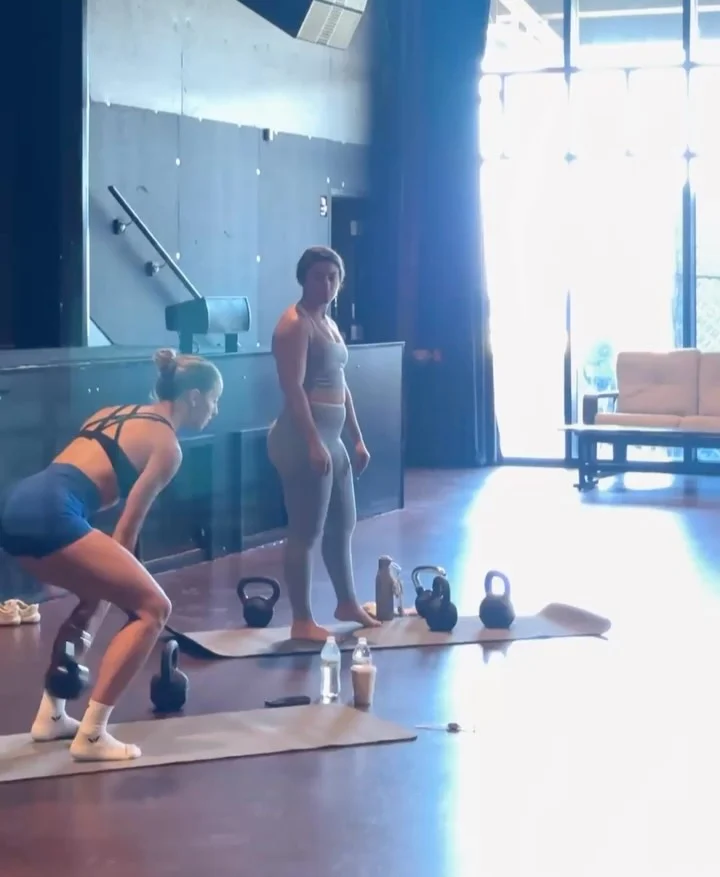
Picture a slow, careful hinge with a bell in both hands, and you saying the same things to yourself you'd say on the mat. That's kettlebell Pilates, roughly, and it's the idea behind Maddie's workshop: Pilates principles carried off the mat and into load.
Madeleine Conti, Maddie to most people, built her Mat Pilates Fusion workshop on that idea, and on Saturday, November 7, at PLTS+ Collective in Austin she takes instructors through it in three parts over two hours.
You'll be doing every bit of it yourself, so wear something you can sweat in, and then you'll turn around and look at how you'd teach the same thing to a client on a Tuesday night. The workshop's own description says the aim is to widen your movement and teaching toolkit, which is about as plain as it gets.
Why a bell, of all things
Hold a bell overhead with a loose middle and it tips toward the window; the client notices that tilt in her own arm before you've even opened your mouth, so the bell ends up doing half the cueing for you. That's useful even for clients who will never go near a heavy one, and for the regulars who have done the hundred a thousand times it is a fresh problem that still runs on principles they already know.
Part 1, foundations
Part 1 covers kettlebell foundations, and the Pilates side shows straight away: alignment and control come long before anyone mentions speed or a heavier bell. If you've never coached a bell, this is where setup gets covered, what a clean start position looks like from the front of the room, and which of your mat cues still work word for word.
Part 2, bridging and core
Part 2 moves down to the mat for bridging variations and integrated core work. Stability and the trunk-to-hip connection are the focus, which is what you're chasing in a plain bridge on a Wednesday anyway. With a bell added and the support shifted around, the variations stack up quickly, and you get to see what the body has been quietly organizing all along.
Part 3, up on your feet
Part 3 gets everyone standing. The sequences borrow from Animal Flow and lean on mobility, coordination and balance, and on control of the whole body at once. For a lot of mat teachers that is the least familiar stretch of the whole weekend, which seems to us like the best possible reason to be in the room for it.
Bringing bells back to your own studio
The workshop promises new movement options you can use in your own practice or teaching right away. Before your first bell class back home, settle the logistics: how many bells you own and in which sizes, and what the client without one does instead. Where do the standing blocks go so a dozen people aren't swinging toward each other? How do you explain a hinge to somebody whose only reference point is a roll-up?
We wrote up the planning side in how to plan a Pilates class, and mixed abilities in our guide for the group Pilates instructor. If the class should move to a beat, Erin Schirack's musicality workshop on Sunday afternoon is a natural follow-on.
When and where
Saturday, November 7, 2026, 12:30 to 2:30 PM Central, right after the Networking Lunch, at 1809 Pearl St, Austin, TX 78701. Tickets and the rest of the timetable are on the PLTS+ Collective page.
Questions
Do I need to have used kettlebells before?
No. Part 1 starts at foundations.
What is the Animal Flow part?
Part 3, after the bridging block: standing sequences inspired by Animal Flow, taken off the mat.
PLTS+ Collective in Austin
Two days of Pilates education, movement and connection, then a virtual follow-up one month later.